Designing for 6.2 Billion Ears

Kristine Botros · Sound designer & Strategy · 5 min read
During the warm summer evenings, I followed the 2026 FIFA World Cup® alongside 6.2 billion other people. There was a healthy amount of drama on the pitch and on social media, and even the halftime show left no one without an opinion. But all the buzz in the world about the winners, losers, singers, and dancers couldn't pull my mind away from the sound.
As I was watching the games, I couldn't stop asking myself: Why do I hear every kick of the ball so clearly? Why can’t I hear the players talking? And who made the sonic signature opening and closing each commercial break? This sent me down one of my usual nerdy spirals, trying to discover everything I could about the sound of the 2026 FIFA World Cup®.
Audience 641x Larger Than the Stadium
If we measure by global television audience, fan engagement, and international reach, this is considered the largest single sporting event in the world—and the 2026 tournament was the biggest one yet.
There is no question about FIFA having a well-developed sound identity for every World Cup, from Shakira's Waka Waka to custom audio logos, theme tracks, and artist collaborations. But one specific aspect of how FIFA works with sound is especially intriguing to explore. To my mind, it is a masterclass in taking sound seriously and reaping the return on that investment every time.
Let's consider the scale of things for starters. For the final game, there were 80,663 people present in the stadium, while at the peak of the match, 51.7 million tuned into the broadcast. That means the broadcast audience was approximately 641 times larger than the live crowd.
So in actuality, the biggest crowd following the game is behind the screen…
It is undeniable that when watching on TV, you hear the ambient crowd roaring like a mighty sea; you hear the ultras behind the goals drumming, chanting, and supporting their favorite team. You hear every kick of the ball, crisp and clear, as if you were right there. And this is exactly what FIFA wants you to hear! A very detailed plan of microphone placement and spatial mixing takes place, all designed to make you feel included. And boy… It works, because it helps attract a crowd 641 times larger than the one present in the stadium.
![A field-level microphone sits on the perimeter behind the end line at Kansas City Stadium, also known as GEHA Field at Arrowhead Stadium. Image credit: Eric Zornes]](https://cdn.sanity.io/images/8lj0qb0z/production/c222115481c6f10589faddc71bd12472c422d425-1024x768.webp?w=1200&fit=max&auto=format)
From Mono to Pitch-Side "Tonmeisters"
Their broadcast philosophy developed over time, hand in hand with the evolution of audio technology. Back in 1954, during the first broadcast hosted in Switzerland, sound was strictly in mono. FIFA's only priority was making sure the commentator could be heard over the crowd and the signal buzz. But as audio tech evolved, their priorities shifted.
In the 1970s, FIFA rolled out their first stereo mixes using microphones placed around the field. A dedicated mixing engineer had to follow the game live, constantly pulling up specific mic channels depending on where the ball moved to keep the sound clear. It immediately made me think of a classical Tonmeister, someone who masters complex audio tech while following a musical score as the orchestra plays. I had no idea sports broadcasting had its own version of this, reading the game live on the pitch instead of notes on a page.
Outsmarting 127 Decibels of Noise
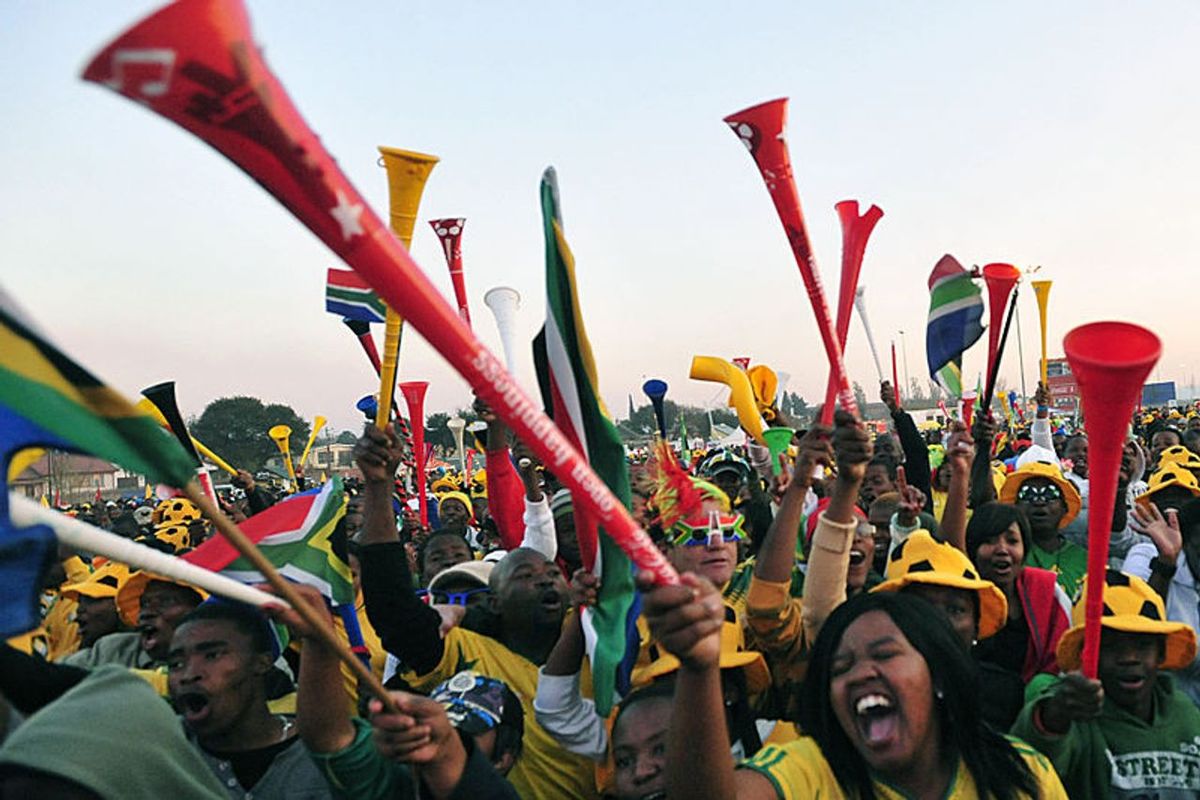
Then came South Africa in 2010 and the infamous vuvuzelas. The relentless 127 dB drone of the horns completely overwhelmed the broadcast microphones. Engineers had to innovate on the spot, rapidly developing real-time digital "notch filters" tuned specifically to 233 Hz. This allowed them to slice the buzzing horns right out of the mix without muffling the true stadium atmosphere or the commentators.
2026: Sound as Equal to Vision
Fast forward to 2026, and FIFA delivered its first full 3D audio broadcast. The system was intricate and complex because, to achieve true immersion, sound had to be treated as equal to the visual input. The audio team used between 30 to 40 pitch-side microphones, almost matching the number of cameras tracking the match visually.
The Ultimate ROI on Audio
There is so much more I could go on about when it comes to the way FIFA uses sound, many nerdy details that I find incredibly fascinating. But what's in it for us? Their long-term commitment to using sound, music, sonic identity, and sensory marketing has established them as one of the strongest brands in modern sports. FIFA sound is a masterclass to study and discuss when it comes to using sound to its fullest potential.
The success of the FIFA World Cup might have something to do with great football and legendary players on the pitch, but as a sound designer, I can’t help but wonder: Is FIFA the largest sporting event in the world and therefore takes sound seriously… or because FIFA takes sound seriously, is it the largest sporting event in the world?