From a small-town music school to the executive table
Calle Stenqvist · Creative Dirctor, Co-Founder · 9 min read
Plan8 was founded by Tor and I almost 20 years ago.Tor and I first met as teenagers at the music school in our small hometown in Sweden. It was the early 90s, and our town had a surprisingly vibrant music scene. There were bands everywhere, playing in basements, rehearsal rooms and small local venues. Tor was a drummer, and I was a singer and guitarist.
Then life happened, and it would be years before we met again. By then, we had both moved to Stockholm after our studies and found ourselves working in the booming early days of the internet. We split our time between writing code and making music, recording our own projects and other aspiring bands in our small studio.
Looking back, that combination turned out to be important.The worlds of web design, coding and digital music production were surprisingly close. Both required a fascination with technology and a willingness to figure things out yourself. One moment you were trying to understand a piece of code The next you were moving a microphone five centimetres or trying to work out why a compressor wasn't doing what you wanted.
That combination of music and technology has followed us ever since.
Learning the advertising world
When we decided to turn the studio into a business, our biggest challenge wasn't really making music, it was figuring out who might pay us to make it.
We knew almost nobody in advertising, film, or design, so the first years were largely about building a network and mapping out the landscape of those industries. Who actually chose the music? Was it the advertising agency? The film director? The production company? The client?
We started knocking on doors in Stockholm and soon began traveling internationally, to Amsterdam, London, New York, Munich, Copenhagen, Oslo, Helsinki, Cape Town, and Dubai.
This was before you could simply send someone a link to your work. We would turn up at agencies carrying our portfolio on a DVD.
Most of it consisted of TV commercials. To get those jobs, we pitched music to film directors and advertising agencies. Sometimes we also worked behind the scenes, pitching ourselves as composers to bigger and more established music houses in London and Amsterdam.
Little by little, the work got better. Better directors. Better agencies. Bigger brands. Cooler films. At this point, our job was fairly straightforward: write a bespoke piece of music to elevate a commercial.
Music and sound design were traditionally treated as two separate disciplines.. A composer wrote the score; a sound designer handled the rest. But we became increasingly interested in the space between them.
Our composers started using sound design elements as part of the music itself. Noises became percussion, textures became rhythms, sounds became musical building blocks. We started calling it musical sound design.
As our network grew, so did our repertoire. We brought in external composers with different specialities and became highly adaptable to almost any brief. Give us a day or two and we'd come back with two or three different musical directions.
But while we were getting better at making music for advertising, something much larger was shifting around us. The internet was maturing.
The birth of the sound engine
People were spending increasingly more time online.
The advertising industry declared that television and other “old media” were dying, which, as it turned out, wasn't really true. Nevertheless, brands became obsessed with building ambitious digital experiences. And then came the era of the interactive microsite.
Calling these things websites doesn't really do them justice. The best ones were somewhere between a website, a video game, an interactive film, and an art installation. They combined video, animation, 3D graphics, music, and sound design into experiences that held attention for ten or twenty minutes.
For us, this was incredibly exciting. We already understood the web. We understood code. And we understood music and sound. Suddenly those disciplines belonged together
But there was a problem.
On a TV commercial, you could simply deliver a finished piece of music. On an interactive website, you couldn't. The music had to respond dynamically to user behavior.
It might need to change when clicked on an object or reached a certain point in a story. Different layers of music might need to start and stop without losing sync. Sound effects had to interact with music. Transitions had to happen seamlessly.
A pre-rendered MP3 wasn't going to cut it.
So we built our own dynamic sound engine.
It served as the brain controlling every audio asset on a site, keeping track of music, sound effects, transitions and interactions. For the next few years, it became something of our secret sauce.
Very few studios were working this way. For a while, we were one of the few places agencies could turn to for genuinely interactive and dynamic music for the web.
Eventually, that led to one particular project: Clouds Over Cuba.
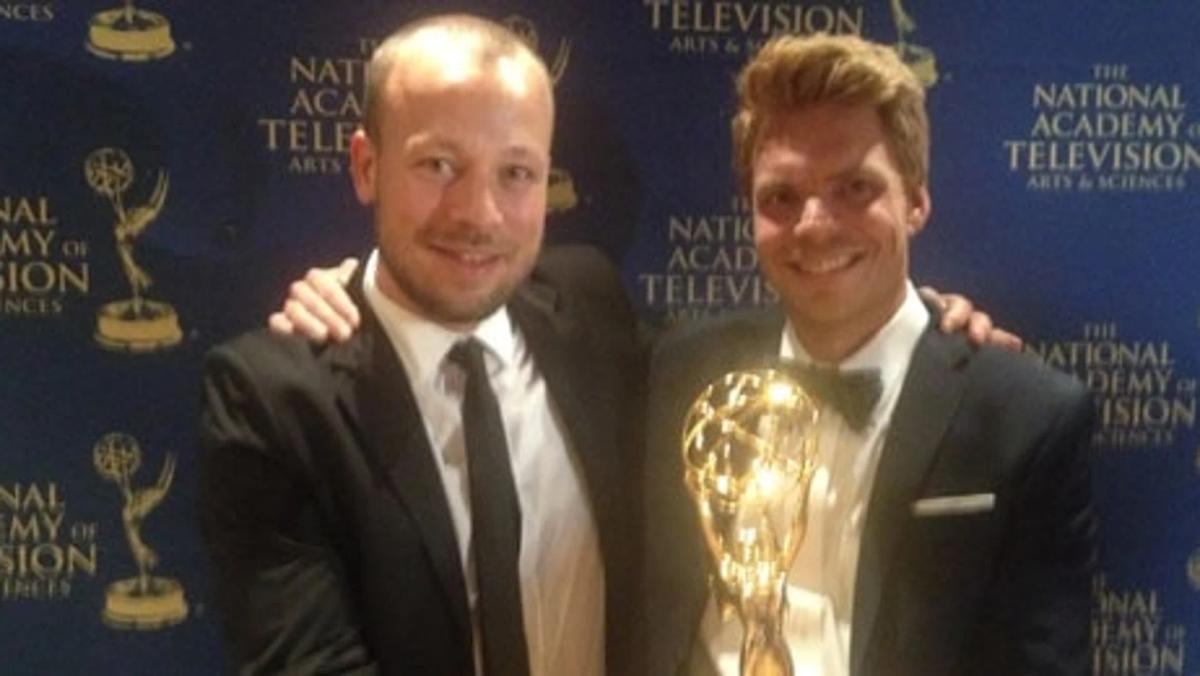
It was an interactive documentary about the Cuban Missile Crisis, created for the JFK Presidential Library, this interactive documentary on the Cuban Missile Crisis combined film, archive material, interactive timelines, music, and sound design. It was precisely the kind of challenge our unique blend of skills had prepared us for In 2012, it won a News & Documentary Emmy award.
Tor and I travelled to New York for the ceremony, returning home to Stockholm carrying a statuette and fairly enormous expectations about what would happen next.
As it turned out, winning an Emmy didn't guarantee any immediate success.
But something else had happened. Without really planning it, we had become an international company.
America
The interactive projects had gradually changed our client base. What had started with directors and agencies in Stockholm was now increasingly dominated by US advertising agencies and digital production companies.
At some point, having most of your clients on the other side of the Atlantic becomes slightly impractical, so we established a US company and Tor and his family packed their lives into boxes and moved to Los Angeles.
The following four years involved a lot of flights across the Atlantic and some extraordinary projects with Google, Meta and other large technology companies.
But once again, the technology around us was changing.
The web was becoming social.
For a while, brands were so convinced that Facebook was the future that some actually shut down their own websites and redirected visitors to their Facebook pages. The elaborate microsites that had filled our calendars began disappearing.
The thing we had become very good at doing was slowly becoming less relevant.
Fortunately for us, something else was taking its place.
When the internet escaped the browser
Brands still wanted experiences. They just didn't want them confined to a traditional web browser.
Increasingly, we found ourselves working on physical installations, exhibitions, launches, retail environments and other interactive experiences. For a group of people obsessed with sound, this was arguably even more interesting.
On the web, sound comes from your computer or headphones. In a physical space, it could surround you.
We could put speakers everywhere. Sound could move across a room. Music could react to where you were standing or how you moved. It could react to your heart rate. Or your driving.
Thanks, Jaguar.
We would build prototypes, write software, connect sensors, move speakers around and invent solutions as we went. Once again, music and technology had taken us somewhere new.
From campaigns to brands
After almost two decades of working in advertising, another realization slowly began to take shape. We knew a lot about brands, yet most of the time we were being asked to solve a very small part of their problem.
An advertising agency might call and say, We need music for this film. So we'd make music for the film. Another agency might call six months later about the same brand and ask us to create sound for an installation. Then someone else would make the sonic logo, choose the music for social media or design the sounds in the product.
Each project could be good on its own, but nobody was necessarily thinking about how they belonged together.
We started wondering whether we could be more useful further upstream. Instead of just asking how this should sound?, we started asking why it should have sound at all? Where and when should sound appear? What job should music and sound actually do for this brand?
That changed our relationship with clients.
We began working directly with brands over longer periods rather than appearing briefly at the end of an advertising production. We could sit alongside a design agency during a rebrand and make sure sound was considered at the same time as colour, typography, motion and language. If a brand was trying to become warmer, simpler, more human or more innovative, we could ask what those same ideas meant in sound.
Our job was no longer simply to make something sound good. It was to understand the problem first. And sometimes the right answer wasn't music. Sometimes it wasn't even sound.
That may be the biggest thing we've learned.
Twenty years later
It took us almost twenty years to go from carrying DVDs around advertising agencies to having a place at the executive table. There wasn't really a plan. We followed the work, but more importantly, we followed our curiosity and that helped us earn their trust
TV commercials led us to sound design, the internet led us to code, code led us to interactive music, and interactive music led us into physical spaces. All those years working inside brands eventually led us to strategy.
The basic idea hasn't changed very much. The difference is that these days, before we start making anything, we've learned to ask why.
It took us twenty years to get here. The next twenty are about making that trust count.
Peace.
/ Calle